Martin Parr transformed documentary photography from a medium of black-and-white social conscience into a saturated, flash-lit examination of consumer culture that made the everyday appear extraordinary and slightly absurd. His death on December 6, 2025, from complications related to myeloma, ends a career that fundamentally changed how photographers—and the public—see leisure, class, and British identity. Through his distinctive aesthetic of garish colours and unflinching close-ups, Parr created what he called “serious photographs disguised as entertainment,” establishing a visual language that continues to influence photographers worldwide.
Parr’s legacy extends far beyond his own images. As a teacher at the University of Wales Newport, Magnum Photos president of Magnum Photos, founder of the Martin Parr Foundation, and prolific curator and book publisher, he built infrastructure that supports photographers at every career stage. His work now resides in the collections of Tate, Centre Pompidou, and MoMA New York, Blindspot Gallery while his influence permeates contemporary street photography, documentary practice, and the broader acceptance of colour photography as a legitimate artistic medium.
Parr’s transition to colour marked a seismic shift in British photography. Influenced by American photographers William Eggleston, Joel Meyerowitz, and Stephen Shore, and by John Hinde’s saturated Butlin’s postcards, he developed an aesthetic that would become instantly recognisable: hyper-saturated colours achieved through amateur film stocks like Fuji 400 Superior and Agfa Ultra, combined with daylight fill-flash that produced a surreal, crystalline quality.
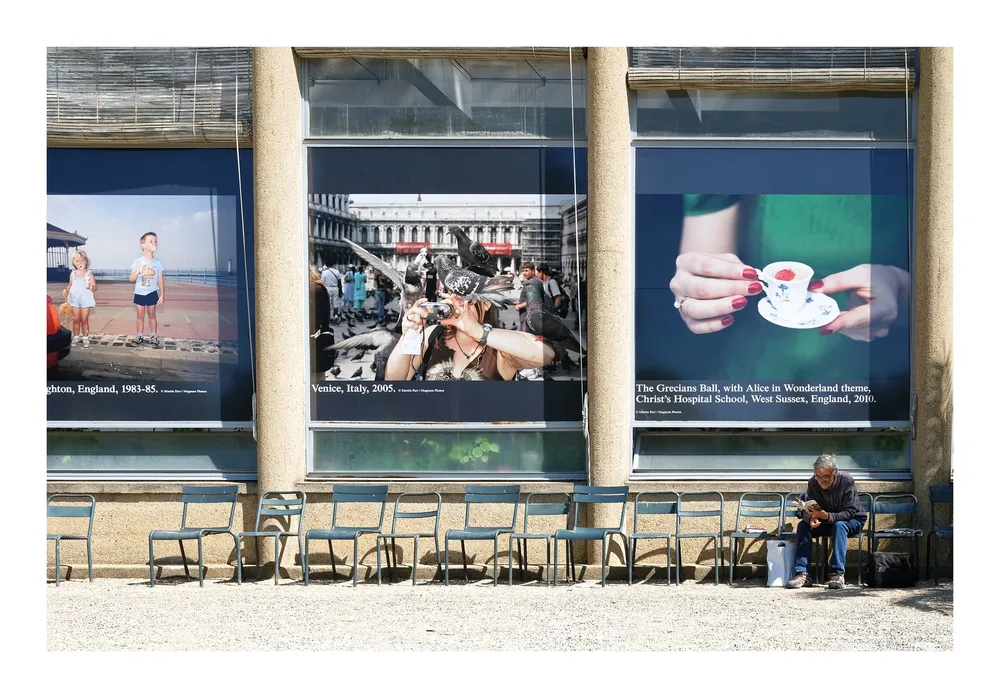
His breakthrough work, The Last Resort (1983-1985), documented working-class holidaymakers at New Brighton, a decaying seaside resort near Liverpool. Shot with a Plaubel Makina 6x7 medium format camera and flash, the series was both revolutionary and deeply controversial. Critic Gerry Badger later wrote that it “represented a seismic change in the basic mode of photographic expression, from monochrome to colour, a fundamental technical change that heralded the development of a new tone in documentary photography.”
Critics accused Parr of cruel exploitation of working-class subjects, describing the work as “a clammy, claustrophobic nightmare world.” Philip Jones Griffiths later called his pictures “fascistic.” Yet Parr captured something truthful about Thatcher-era Britain—a country experiencing economic decline while still finding pleasure where it could. The Guardian eventually named The Last Resort one of “1000 Artworks to See Before You Die.”
In 1995, Parr began using a Nikon 60mm macro lens with ring flash, enabling the extreme close-ups that became his signature technique. This equipment allowed him to photograph half-eaten food, lipstick-smudged glasses, and wrinkled skin with clinical precision, putting subjects “under the microscope” in their own environments. The technique debuted in Common Sense (1995-1999), exhibited simultaneously in 41 venues across 17 countries—an unprecedented global documentation of consumer culture.
Parr joined as Professor of Photography from 2004 to 2012, teaching part-time while maintaining his active photography career. His appointment came 31 years after the program’s founding, joining a distinguished lineage of working photographers who taught there, including Keith Arnatt, Daniel Meadows, and visiting lecturer Josef Koudelka.
Parr’s teaching philosophy emphasised individuality and professional practice. “The most satisfying and the most challenging part is just responding to students’ works, seeing what they’re doing and trying to encourage them to push it forward, and make it more interesting, more resolved,” World Photography Organisation he explained. He taught by example, demonstrating that photographers could sustain careers through commercial work, book publishing, and institutional engagement simultaneously.
Notable photographers connected to Newport include Paul Reas (who later became course leader), Tom Jenkins, Ivor Prickett, Jack Latham, Clementine Schneidermann, and Lúa Ribeira—graduates informally called the “Newport Mafia” for their dominance in picture editor and art director positions. David Hurn himself noted that Parr was “unrelenting in the promotion of photography among the young.”
Parr’s admission to Magnum Photos became the most contentious membership vote in the agency’s history. He joined as an associate in 1988 but faced fierce opposition when seeking full membership in 1994. Philip Jones Griffiths circulated a letter declaring: “He is an unusual photographer in the sense that he has always shunned the values that Magnum was built on… His membership would not be a proclamation of diversity but the rejection of those values that have given Magnum the status it has in the world today.”
Henri Cartier-Bresson famously dismissed Parr as “an alien from another planet,” though he later reconciled this assessment, writing: “We belong to two different solar systems—and why not?” The vote passed by a single ballot—the narrowest possible margin for the required two-thirds majority.
Despite the contentious entry, Parr eventually served as President of Magnum Photos International from 2013 to 2017, modernising the agency and helping it adapt to declining editorial markets by expanding into fashion and advertising photography. His tenure represented a complete transformation of Magnum’s identity, from an agency rooted in black-and-white humanistic photojournalism to one embracing colour, irony, and commercial opportunities.
The Martin Parr Foundation, established in 2014 and opened to the public in Bristol in October 2017, continues his legacy of supporting “emerging, established and overlooked photographers.” Its mission includes preserving British and Irish photography through exhibitions, a 5,000-book library, and the archives of photographers including David Hurn. Parr himself funded the foundation primarily through his print sales and photobook collection, which he sold to Tate.
Parr’s photographic style operates through deliberate technical choices that create maximum visual impact while maintaining documentary authenticity. His use of saturated amateur film stocks produced vivid colours without digital manipulation—“I don’t push the colours, I don’t take things out… I believe in the integrity of the image,” he stated. The combination of bright flash with already-saturated film creates what appears artificial while documenting real moments.
His daylight flash technique eliminates shadows and flattens images while making colours pop, producing a surreal quality that distances reality from the photograph. The ring flash, functioning “like a portable studio light,” enables extreme close-ups that reveal uncomfortable details: food textures, skin imperfections, the materiality of consumer goods. This technique transforms mundane objects, Princess Diana mugs, plastic beach buckets, mass-produced pastries, into signifiers of cultural excess.
Thematically, Parr documented all social classes with the same unsentimental eye. The Last Resort examined working-class leisure; The Cost of Living (1987-1989) captured middle-class Thatcher-era aspiration around Bristol and Bath; Think of England (1999-2000) surveyed English national identity from Ascot to seaside resorts. As one critic observed: “The English people participating in traditional upper class activities—polo, horse racing, fox hunting—look no different from tattooed sunbathers. Their skin is just as bad.”
His subject matter consistently explores leisure, food, shopping, tourism, and social rituals—the “more surreal aspects of daily life” that familiarity renders invisible. Parr believed his role was highlighting how strange everyday life actually is, stating: “The fundamental thing I’m exploring constantly is the difference between the mythology of the place and the reality of it.”
Parr’s work emerged from and contributed to broader transformations in documentary photography. The genre’s “golden age” in the 1930s, exemplified by Farm Security Administration photographers Walker Evans and Dorothea Lange, used photography explicitly for social reform—exposing poverty to advocate change. Henri Cartier-Bresson’s concept of “the decisive moment” and Magnum Photos’ founding in 1947 established photojournalistic standards emphasising black-and-white imagery and humanistic purpose.
The 1967 “New Documents” exhibition at MoMA marked a crucial shift. Curator John Szarkowski declared that photographers Diane Arbus, Lee Friedlander, and Garry Winogrand had “redirected the technique and aesthetic of documentary photography to more personal ends. Their aim has been not to reform life, but to know it.” This philosophical transition, from persuasion to understanding, opened space for Parr’s later work.
The New Topographics movement (1975) documented man-altered landscapes with neutral detachment, while the New Colour movement pioneered by William Eggleston legitimised colour photography as fine art. Eggleston’s 1976 MoMA exhibition, initially dismissed by critics as “perfectly banal” and “perfectly boring,” established colour’s artistic validity. Cartier-Bresson had told Eggleston: “You know, William, colour is bullshit”—yet within a decade, Parr was transforming British documentary through precisely this medium.
Contemporary documentary photography has blurred boundaries between fact and fiction, document and art. Photographers like Jeff Wall and Gregory Crewdson create meticulously staged “documentary-style” images, while “post-documentary” practitioners incorporate AI-generated elements and multimedia storytelling. The migration from magazines to galleries has repositioned documentary photography within fine art contexts, raising questions about photographic truth that Parr’s work anticipated through its deliberate aesthetic manipulation.
Martin Parr’s contribution to photography extends beyond his images to encompass institutional transformation, and educational influence. By legitimising saturated colour and ironic observation within documentary practice, he expanded what the medium could address and how it could speak. His willingness to photograph consumerism, leisure, and everyday absurdity, rather than tragedy alone, democratised documentary subjects while his technical innovation created a visual language adopted worldwide.
The debates Parr sparked about exploitation versus celebration, cruelty versus honesty, remain unresolved precisely because his work refuses easy categorisation. His photographs simultaneously critique and participate in the consumer culture they document, a tension he embraced: “I am a real British. I think this can be seen in my photographs. My photographs are often a study of my own hypocrisy.”
Contemporary documentary photography bears his influence in its acceptance of colour, its attention to mundane subjects, and its comfort with ambiguity. The “serious photographs disguised as entertainment” model he pioneered has spawned successors who take entertainment seriously while finding new ways to be serious. In this sense, Parr’s greatest legacy may be demonstrating that documentary photography could be anything, as long as it remained curious about how we actually live.
Photograph: “Martin Parr … I don’t know him” by madras91, CC BY 2.0